

Good kitchen cabinet organization starts with the way you prepare meals, unload groceries, and move through the room. The most useful plan puts everyday items within easy reach, groups storage by task, uses vertical space intentionally, and reserves custom features for awkward corners, deep cabinets, and gaps that standard pieces cannot solve.
Plan your kitchen storage with Creative Closets
Why does kitchen cabinet organization begin with how you use the room?
Kitchen cabinet organization works best when storage follows your routines instead of forcing every item into a generic category. Start by observing where you stand when you prep, cook, serve, clean, and put groceries away. Then assign storage to those activity zones, keeping the items used most often closest to the point where they are needed.
Make a use-based inventory before choosing accessories
Emptying every cabinet at once can make a project feel larger than it is. Instead, make a short inventory by task. Note which items are used daily, weekly, seasonally, or only when entertaining. Record bulky pieces, heavy cookware, fragile dishes, tall bottles, cutting boards, baking sheets, and small tools that disappear behind larger items.
- Daily cooking: Keep pans, knives, utensils, oils, and seasonings near the primary prep and cooking areas.
- Serving: Store plates, bowls, glasses, and serving pieces close to the dishwasher or the place where meals are served.
- Baking: Group baking sheets, mixing bowls, measuring tools, and ingredients near a clear work surface.
- Cleaning: Keep dish towels, cleaning supplies, and waste or recycling accessories together, while separating chemicals from food storage.
- Seasonal storage: Move rarely used platters and specialty equipment to higher or less central cabinets.
This inventory also reveals what should not occupy prime cabinet space. Duplicates, damaged items, and tools that no longer fit your routines can be addressed before a designer measures the room. The goal is not to fill every shelf. It is to make the storage you keep easier to see, reach, and return.
How should you divide kitchen cabinets into practical zones?
A zoned kitchen cabinet layout assigns each section of storage to a repeatable activity. Prep, cooking, cleanup, serving, and pantry-adjacent storage should support one another without competing for the same drawer or shelf. This approach reduces unnecessary movement and makes it easier for everyone in the home to return items to the right place.
Build the layout around five common zones
- Prep zone: Place cutting boards, knives, mixing bowls, colanders, and frequently used tools near the main preparation surface.
- Cooking zone: Keep pots, pans, lids, trivets, oils, and cooking utensils near the range or cooktop. Deep lower drawers can make heavy cookware easier to access.
- Cleanup zone: Organize dishware, towels, and cleaning accessories around the sink and dishwasher. A drawer or pull-out beside the dishwasher can simplify unloading.
- Serving zone: Store everyday plates, bowls, glasses, and flatware where they can be reached without crossing the busiest cooking path.
- Pantry-adjacent zone: Use nearby cabinets for overflow categories such as snack items, small appliances, paper goods, or entertaining pieces that do not belong in the main prep area.
Zones do not need to follow a rigid left-to-right formula. The right arrangement depends on the kitchen’s walls, windows, appliances, doors, outlets, and the handedness of the people who use it. A custom designer can map the storage plan to those fixed conditions rather than asking the room to accommodate a standard layout.
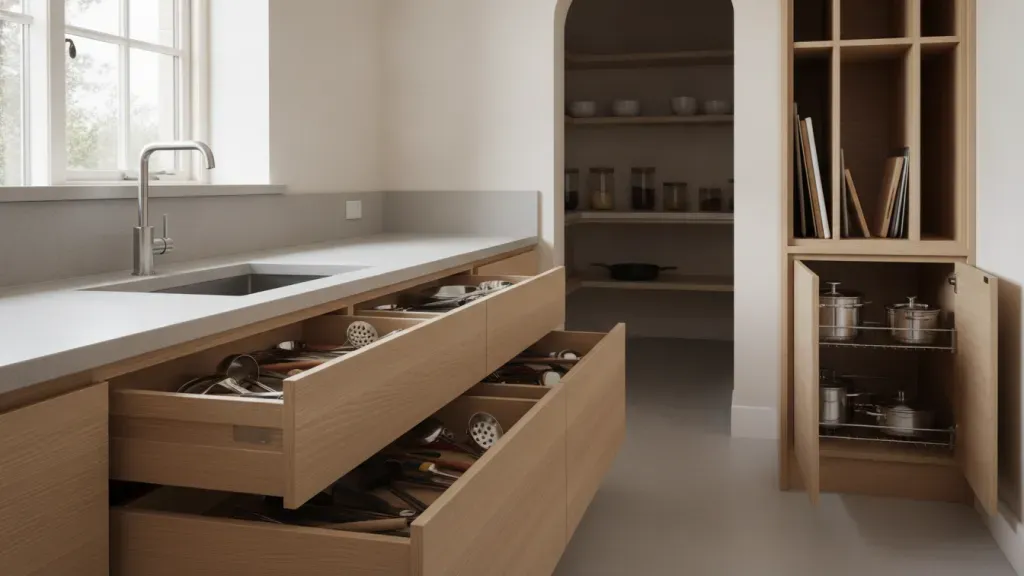
Where should everyday items go based on cabinet height and access?
Cabinet height should reflect both how often an item is used and how safely it can be reached. Place daily-use items in the most accessible middle and lower areas, use upper shelves for lighter or occasional pieces, and avoid making heavy cookware dependent on awkward lifting. Visibility matters as much as capacity.
| Storage area | Best use | Planning note |
|---|---|---|
| Lower drawers | Pots, pans, lids, utensils, and food-prep tools | Use full-extension access where possible so contents are visible instead of hidden at the back. |
| Middle cabinets and drawers | Everyday dishes, glasses, flatware, spices, and prep tools | Reserve this comfortable reach zone for items used throughout the week. |
| Upper shelves | Light serving pieces, backup supplies, and occasional items | Avoid storing heavy or fragile items where a step stool is needed. |
| Tall or narrow sections | Baking sheets, trays, cutting boards, bottles, and broom-height items | Vertical dividers or narrow pull-outs can prevent flat items from becoming a leaning stack. |
Accessibility is also about the cabinet opening itself. A shelf that is technically reachable may still be inconvenient if a door blocks the adjacent work area or if a deep shelf requires unloading several items. Adjustable shelves, drawer boxes, and pull-out trays can improve access without changing the footprint of the kitchen.
Explore custom kitchen pantry and cabinet storage options
Which cabinet features make organization easier to maintain?
The most effective cabinet features remove a recurring point of friction. Drawers make contents visible from above, pull-outs bring deep storage forward, dividers keep flat items upright, and adjustable shelves allow the layout to change as routines change. Choose features based on the object and the motion required to use it.
Match the feature to the storage problem
- Deep lower cabinets: Consider pull-out trays or drawers so cookware does not disappear behind the first row.
- Corner cabinets: Use a layout that improves access to the full corner rather than leaving a large, difficult-to-reach void.
- Flat cookware: Vertical dividers can organize baking sheets, cutting boards, cooling racks, and trays without stacking.
- Small tools: Shallow drawers with dividers can separate measuring spoons, peelers, clips, and other frequently misplaced pieces.
- Spices and bottles: A dedicated drawer or narrow pull-out can keep labels visible and prevent short containers from being lost behind tall ones.
- Heavy items: Lower drawers or sturdy pull-outs can reduce awkward reaching and make the weight of the item easier to manage.
- Adjustable storage: Movable shelves help accommodate changes in cookware, serving pieces, and small appliances over time.
Built-in features should also complement the cabinet style and surrounding finishes. Creative Closets can help coordinate storage components with the kitchen’s existing colors, hardware, and proportions so the organization looks intentional rather than added later.
How should you evaluate cabinet materials and hardware?
Cabinet materials and hardware should be judged by the work each section must perform. Look at moisture exposure, cleaning needs, drawer load, door movement, finish coordination, and expected use before choosing a surface or mechanism. A strong organization plan balances appearance with dependable access and a clear maintenance routine.
Ask practical questions about the finished system
Material names alone do not explain how a cabinet will function in your kitchen. Ask how the panels, edges, shelves, drawer boxes, hinges, and slides are constructed, and how each component is suited to its location. Areas near a sink may need a different maintenance conversation than a dry upper cabinet. Lower storage for cookware should also be evaluated differently from a shelf holding lightweight serving pieces.
- Surface care: Confirm how the finish should be cleaned and whether it resists the everyday splashes, grease, and wiping common in a kitchen.
- Drawer movement: Ask how far drawers extend and how the hardware supports the items assigned to each drawer.
- Shelf flexibility: Check whether shelves can be adjusted if containers, appliances, or serving pieces change later.
- Door clearance: Make sure hinges and door swings work beside appliances, corners, and neighboring drawers.
- Finish coordination: Compare colors, textures, handles, and edge details with the existing kitchen so new storage feels integrated.
These questions also make project comparisons more useful. Instead of looking only at the number of shelves, compare the design scope, measurement process, component specifications, installation responsibilities, and support after installation. Creative Closets can review those decisions during an in-home design appointment and connect the storage features to the actual kitchen conditions.
How do you plan cabinet storage around drawers, doors, and clearances?
Measurements are the foundation of useful kitchen cabinet organization. Before choosing drawers, shelves, or pull-outs, account for the cabinet opening, interior depth, door swing, adjacent appliances. Countertop overhang, trim, outlets, plumbing, and the space needed to stand comfortably in front of the storage.
Use a practical measurement checklist
- Measure the full wall length, ceiling height, and the width of each cabinet opening.
- Record interior depth, shelf spacing, drawer dimensions, and any obstructions inside the cabinet.
- Note the location of sinks, ranges, refrigerators, dishwashers, windows, doors, vents, and electrical outlets.
- Measure the largest items that need a home, including pan handles, appliance cords, mixing bowls, trays, and tall bottles.
- Check how cabinet doors and drawers open beside one another and beside appliances.
- Identify items that need a landing area immediately beside a prep or cooking surface.
- Separate daily-use items from seasonal or entertaining pieces before assigning prime storage.
Clearances are especially important in kitchens with islands, narrow walkways, or multiple people working at the same time. A cabinet that holds more but makes two doors collide is not an improvement. Good planning protects the flow of the room while increasing usable storage.

When is custom kitchen cabinet organization worth considering?
Custom kitchen cabinet organization is most useful when the room contains awkward dimensions, wasted corners, deep storage, unusual appliances, or routines that standard accessories do not support. The decision should be based on usable access and long-term function, not on maximizing the number of shelves or adding every available accessory.
Look for signs that a tailored plan would help
- Cabinet gaps or filler spaces are taking up valuable wall area.
- Deep shelves hide food, cookware, or small appliances from view.
- Corner cabinets are difficult to reach without moving several items.
- Drawers do not fit the tools or containers used most often.
- Upper cabinets hold heavy items that are inconvenient to retrieve.
- Cabinet doors, appliance doors, or drawers interfere with one another.
- The kitchen needs to support more than one primary cook or a specific entertaining routine.
- The storage plan must coordinate with an adjoining pantry or another organized space.
Custom does not mean every cabinet needs a specialized insert. A thoughtful plan may combine standard shelves with a few carefully selected drawers, pull-outs, dividers, or adjustable sections. The value comes from fitting the storage to the room and the household’s habits.
For homeowners comparing options, start with the design scope: what will be measured. Which materials and hardware are included, how installation is handled, and how future adjustments are supported. Creative Closets provides in-home design services for homeowners in King and Pierce Counties. Allowing the plan to be developed around the actual kitchen rather than an abstract cabinet diagram. Review the factors that shape a custom kitchen storage project before requesting a project-specific quote.
How can pantry adjacency improve the rest of the kitchen?
A pantry should extend the kitchen’s storage logic, not become a separate place where categories disappear. Keep high-frequency ingredients and tools close to the work zones, then use pantry-adjacent cabinets for backup supplies. Bulky appliances, entertaining pieces, and items that need more vertical or deeper storage.
Coordinate the cabinet and pantry boundaries
Start by deciding which categories belong in the main cabinet run and which belong in the pantry. Everyday oils, spices, dishes, and cooking tools should remain close to the surface where they are used. Backup packages, serving platters, small appliances, and seasonal items can move to a nearby pantry if they remain labeled, visible, and easy to retrieve.
Think about the handoff between spaces as well. If groceries enter through one path, reserve a logical landing area for items that need to be put away quickly. If the dishwasher opens into a narrow aisle, keep everyday dish storage nearby but not where an open door blocks the walkway. When the pantry is across the room, a small group of frequently used staples may deserve cabinet space even when more capacity exists elsewhere.
Pantry adjacency can also support a cleaner visual rhythm. Use the main cabinet run for items that belong in the daily workflow. And use taller or deeper storage for reserve categories that do not need to stay on the counter. This separation makes it easier to see what needs replenishing without making every cabinet carry every category.
Pay attention to duplication. A household may store the same category in three places simply because the cabinet layout lacks a clear home for it. A combined plan can keep one primary location for each category while using pantry shelves for reserve stock. If a pantry needs its own redesign, the existing kitchen pantry cabinet sizes guide explains how depth, width, and height affect access.
Appliances deserve their own decision. Items used every morning may belong in a cabinet or appliance garage close to the countertop. Items used occasionally may be better placed in a pantry or tall cabinet, provided their weight and dimensions are considered. See the appliance garage cabinet guide for that specialized planning question.
Talk with Creative Closets about a kitchen storage plan built around your routines
Frequently Asked Questions: Kitchen Cabinet Organization
What is the best way to organize kitchen cabinets?
The best approach is to group items by kitchen task, then place daily-use items in the easiest-to-reach drawers and shelves. Keep cooking tools near the range, prep tools near the main work surface. Dishes near the dishwasher or serving area, and reserve higher or deeper storage for lighter or occasional items.
How do you decide where to put things in kitchen cabinets?
Use frequency, weight, size, and point of use. Items used every day should be visible and close to the activity zone where they are needed. Heavy cookware generally belongs in lower drawers or pull-outs, while light serving pieces and seasonal items can use upper or less central cabinets.
What is the most useful organizer for a deep kitchen cabinet?
A pull-out shelf or full-extension drawer is often useful because it brings items at the back forward into view. The right choice depends on the cabinet width, depth, opening, load, and the objects stored there. Measure the cabinet and the items before selecting a feature.
How do you organize pots and pans in kitchen cabinets?
Keep pots, pans, lids, and cooking tools in the cooking zone, preferably in lower drawers or pull-outs that support the weight and make contents visible. Vertical dividers can separate flat lids and baking sheets, while a drawer layout can prevent handles from blocking adjacent items.
When should I consider custom kitchen cabinet organization?
Consider a custom plan when standard storage leaves gaps, hides items in deep corners, creates door conflicts, or fails to fit the way your household cooks. A measured design can coordinate cabinet dimensions, drawers, pull-outs, pantry adjacency, finishes, and clearances around the existing kitchen.
Ready to make your kitchen easier to use?
A well-planned cabinet layout can make everyday cooking, cleanup, and entertaining feel more orderly without changing the way the room is used. The right next step is a design conversation based on your measurements, storage challenges, and daily routines.
Schedule a kitchen storage design consultation with Creative Closets