

Custom closet accessories can make a closet work better, but only when each addition has a clear job. Before choosing a valet rod, drawer insert, shoe shelf, or hamper, think about what you reach for, where clutter gathers, and how you move through the space each day.
What should you decide before choosing custom closet accessories?
Start with your routine, not a list of products. Watch how you use the closet for a week. Note what gets left on a chair, what is hard to find, and what tends to spill onto the floor. A useful accessory addresses one of those repeated problems.
- Daily items: Keep frequently worn shoes, bags, and clothing easy to reach.
- Small items: Give jewelry, belts, ties, and other small belongings a defined home.
- Laundry: Decide where worn clothes collect and whether a hamper belongs inside the closet.
- Occasional items: Store seasonal or formal items higher or farther from the main path.
Then measure the available space and account for doors, drawers, and walking clearance. An accessory that blocks a door or crowds a narrow aisle can create a new annoyance instead of solving one. If you are still planning the overall layout, review this custom closet design guide first.
Which accessories solve common storage problems?
Different accessories suit different habits. The table below is a starting point, not a checklist. Choose only features that fit your belongings and available space.
| Accessory | Useful when | Plan for |
|---|---|---|
| Adjustable shelves | You store folded clothes, bags, or bins in changing groupings | Set shelf spacing to the items you own and leave room to reach them |
| Shoe shelves or angled shoe storage | Shoes are difficult to see or pile up at the bottom | Count pairs and consider boots or taller footwear separately |
| Drawer dividers or inserts | Small garments or accessories get mixed together | Match compartments to the items you actually keep |
| Valet rod | You set out outfits or need a temporary place for a garment | Place it where an extended rod will not obstruct a walkway |
| Pull-out hamper | Worn clothes collect in a basket elsewhere | Allow room to pull it out and remove the bag |
| Hooks or belt and tie storage | Frequently used items are easier to grab when visible | Choose a location that does not crowd hanging clothes |
How do you match closet accessories to your routine?
For shoes and everyday outfits
Begin with the shoes you wear most often. A low, open shelf near the closet entrance can make daily pairs easy to put away. Less-used shoes can go higher, provided they remain reachable. If you want a dedicated shoe zone, compare the options in this guide to walk-in closet shoe storage.
Think about the entire outfit, too. A valet rod can hold a jacket or outfit while you get ready. Hooks may help with a robe or bag. Keep these features near the dressing area, rather than placing them wherever an empty wall happens to be.
For jewelry, belts, and other small items
Small items disappear when they share an open shelf with larger belongings. A divided drawer can separate jewelry, belts, watches, or ties. Open trays make contents visible; drawers offer a more contained look. Consider the size and number of items before selecting compartments, so the insert does not leave awkward unused spaces.
Think through what you want within arm’s reach and what can be stored elsewhere. This can help determine whether a drawer insert, a hook, or a small shelf makes the most sense. For other add-on ideas, see the closet accessories overview.
For laundry and changing clothes
A pull-out hamper can keep laundry off the floor, but it needs enough room to slide out. Check whether a full bag can be lifted out without hitting a shelf or door. If more than one person uses the closet, separate containers may make sorting easier. Keep clean clothes and laundry paths distinct, especially in a compact reach-in.
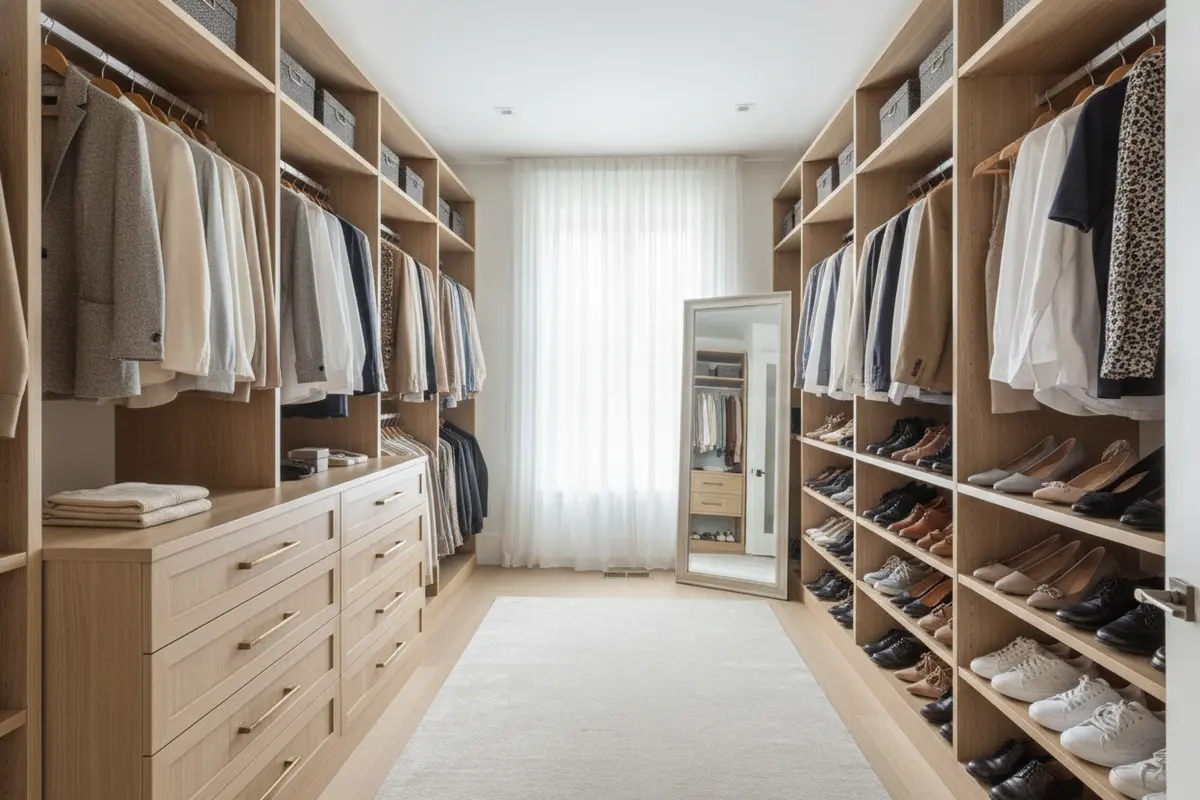
For a shared or changing wardrobe
Shared closets benefit from clear zones. Assign each person a section for hanging clothes, folded items, and accessories. Adjustable shelves can adapt as needs change, while labeled bins may help with occasional items. Avoid adding duplicate features simply to make the layout symmetrical; a useful plan responds to what each person owns and uses.
How do you keep accessories from crowding the closet?
Accessories take up space, so plan their footprint along with the storage they provide. Before settling on a feature, check these details:
- Measure the usable area. Record width, depth, and height, including trim and any obstructions.
- Check movement. Make sure doors, drawers, and pull-outs can open without collision.
- Count the items. Estimate the shoes, bags, or garments that need a home now, plus reasonable room for change.
- Prioritize access. Put daily-use items where they are comfortable to reach; reserve harder-to-reach areas for occasional belongings.
- Leave breathing room. A closet packed to its limit can be harder to use and maintain.
Closet depth and layout affect which add-ons will fit. These walk-in closet dimensions provide a useful planning reference. For a smaller bedroom space, consider the distinct needs of a bedroom closet system.
Which additions should you prioritize first?
When you have several ideas, rank them by how often they solve a real inconvenience. One practical method is to note each problem and its frequency:
- Every day: A missing place for shoes or a useful spot to hang tomorrow’s outfit may deserve early attention.
- Several times a week: Dividers or a dedicated bag shelf can help if those items repeatedly become disorganized.
- Occasionally: Storage for seasonal accessories can be planned in a less prominent area.
Next, compare the benefit with the space required. A pull-out feature can be convenient but needs clearance. A fixed shelf is simple to access but may not contain small objects. A drawer can conceal clutter but requires room to open. The right choice is the one that supports your routine without making the rest of the closet harder to use.
Keep the design flexible where possible. If your clothing mix changes, adjustable shelving can be easier to adapt than a layout built around one fixed set of items. For a broader overview of planning and storage choices, browse closet storage systems.
How do different closet types change accessory choices?
A walk-in usually offers more room to separate storage zones, but its shape still matters. A narrow aisle can make a deep pull-out awkward even when there is ample wall space. Place features you use often along the easiest route. In a larger room, avoid scattering related items across several walls; keeping shoes, clothing, and dressing aids in a sensible sequence reduces backtracking.
A reach-in closet calls for tighter decisions. The opening and door style determine which areas remain easy to access. Open shelves near the front are often simpler to reach than items behind a deep row of hanging clothes. A shallow drawer or divided shelf may suit small accessories, while bulky features can take up space needed for everyday hanging. Learn more about planning a bedroom closet system around the room and its use.
For a wardrobe closet, think about how the unit relates to nearby furniture and the room’s circulation. A valet rod or open shelf should not interfere with a bed, dresser, or doorway. The goal is not to fit every accessory into the closet; it is to give belongings a convenient home without making the room harder to move through. A custom wardrobe closet can be planned for a room without a built-in closet.
How can you work through a real closet example?
Imagine a homeowner whose shoes line the floor, belts are hard to find, and worn clothes pile up near the bedroom door. It may be tempting to add shoe racks, drawers, hooks, and a hamper all at once. Instead, list each friction point and test one solution against space and routine.
- Shoes: Count the pairs used weekly and separate them from formal or seasonal pairs. Give daily pairs an accessible shelf and place occasional footwear elsewhere.
- Belts: Check whether a divided drawer has spare capacity or whether a small hook near the dressing area is easier to use.
- Laundry: Mark the space needed for the hamper to extend, then confirm the bag can be lifted out without hitting clothing or a door.
- Trial the sequence: Walk through getting dressed: choose clothes, retrieve shoes, put away accessories, and place worn items in the hamper. If a feature interrupts that flow, reconsider its location.
This sequence also reveals what does not need a dedicated accessory. If belts are used only occasionally and already fit in a drawer, a new rack may not solve a meaningful problem. Prioritize the repeated pain point, then leave room to reassess after using the layout.
What should you bring to a closet design consultation?
A little preparation helps turn ideas into a useful plan. Bring or note:
- Photos of the closet and the adjoining room, including door openings and any obstacles.
- A rough count of shoes, hanging garments, folded items, bags, and accessories.
- The items that cause the most daily frustration, plus where you would like them stored.
- Any features you already know you want, and any you are unsure about.
- Measurements if you have them, while leaving final verification to the design process.
It can also help to sort belongings into daily, occasional, and seasonal groups before the visit. You do not need to have every accessory selected in advance. A designer can help relate your list to the space and discuss which features fit the intended use. Creative Closets serves homeowners in King and Pierce Counties; see the service area information for coverage.

How do you prepare a useful accessory list?
Before a design conversation, make a short inventory by category rather than trying to record every item. For example, note the approximate number of hanging garments, folded stacks, everyday shoes, occasional footwear, bags, and small accessories. Add a note beside anything awkward to store, such as tall boots, long dresses, or a bulky bag. These details help distinguish a real storage need from an attractive feature that may not suit your belongings.
Also describe who uses the closet and when. A shared closet may need zones that keep each person’s daily items separate. Someone who gets dressed in a hurry may value clear visibility and quick access. A household that rotates seasonal clothes may need upper shelves or bins that can be reached safely. Describe the routine plainly; the purpose is to shape a layout around how the space works, not to arrive with a finished design.
If the closet is part of a larger storage project, clarify which items belong there and which belong in another room. Bags used at the front door might be better stored in an entry area, while sports equipment may belong elsewhere. Creative Closets also offers entryway storage for belongings that need a place near the door.
Frequently Asked Questions
Do I need an accessory in every part of my closet?
No. Start with the areas where a specific problem occurs. Open space can be useful, and not every shelf needs a divider or insert.
Are pull-out accessories useful in a small closet?
They can be, if there is enough clearance for them to extend and for you to use them comfortably. Measure the space in front of the feature as well as inside the closet.
What is the first accessory to consider?
There is no single best choice for everyone. Identify the item that most often ends up misplaced or in the way, then consider a storage feature that gives it a practical home.
Can accessories be planned for a reach-in closet?
Yes. A reach-in can use shelves, drawers, hooks, and other features, but depth and door access affect what fits. Start with the layout and the items you need to store.
Thoughtful custom closet accessories make everyday storage easier when they fit your belongings, your room, and the way you use the space.